
Aged Debtors Report for SMEs
A simple, clear tool that shows who owes you money, how long they’ve owed it, and which overdue amounts sit in each ageing bucket.
Designed for real‑world SMEs — even if you don’t use formal payment terms — this report gives you instant visibility over your cashflow and where it’s slowing down.
1. How this tool works
This tool instantly shows you who owes you money, how long they’ve owed it, and which overdue amounts fall into each ageing bucket. It’s designed for real‑world SMEs — even if you don’t use formal payment terms or credit policies.
Once you enter your invoice details, the report automatically:
- calculates the due date
- works out days overdue
- places overdue amounts into the correct ageing bucket
- updates totals and percentages
- keeps the sheet clean and protected
It’s a fast, practical way to get visibility over your cashflow without needing complex spreadsheets or accounting knowledge.
2. Download the tool and enter your data:
Download the Aged Debtors Report in your preferred format:
- Excel version (fully protected, ready to use)
- Google Sheets version (ideal for mobile or shared access)
- Instructions PDF (step‑by‑step guidance)
Once downloaded, enter your invoice details into the coloured cells. The report updates automatically as you type.
This mirrors your existing calculator structure but adapts it for downloadable tools.
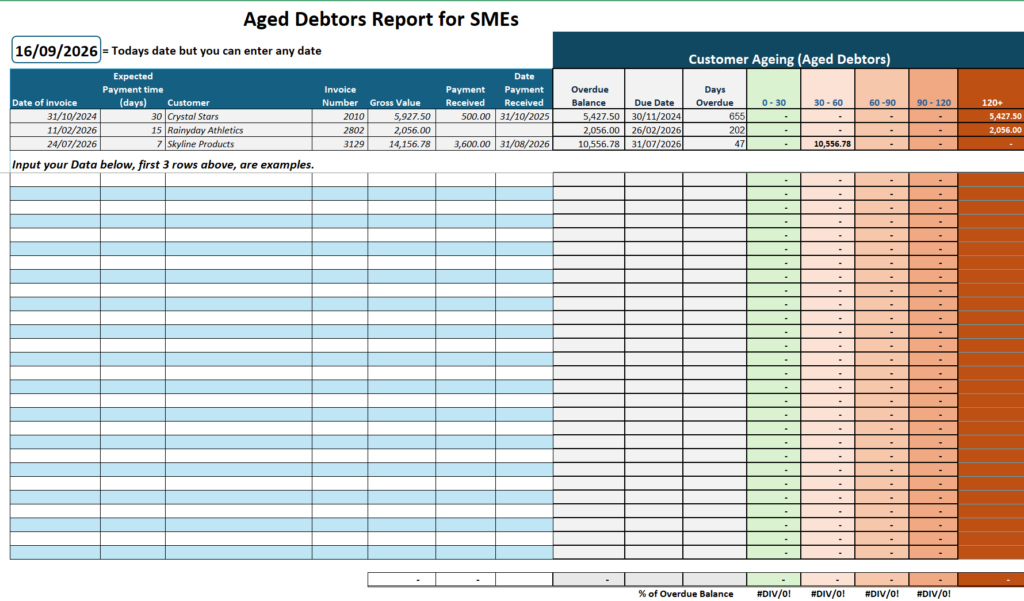
3. Worked Example
A small SME enters their invoice list — nothing formal, just dates, values, and any payments received.
The tool immediately shows:
- several customers in 0–30 days
- a handful slipping into 30–60 days
- a few invoices sitting in 60–90 days
- one customer quietly building a £12,000 overdue balance across multiple invoices
Nothing “suddenly” went wrong — the overdue amounts simply built up over time without visibility.
The report makes the pattern obvious..
4. Why this matters
Most SMEs don’t realise how quickly overdue balances grow — or how long customers have been drifting past expected payment times.
This tool helps you:
- see overdue balances clearly
- understand where cashflow is slowing down
- spot early Drift in customer payment behaviour
- prioritise who needs attention first
- make better operational decisions
- avoid surprises
It’s one of the core tools in the SGA Cashflow & Behaviour discipline.